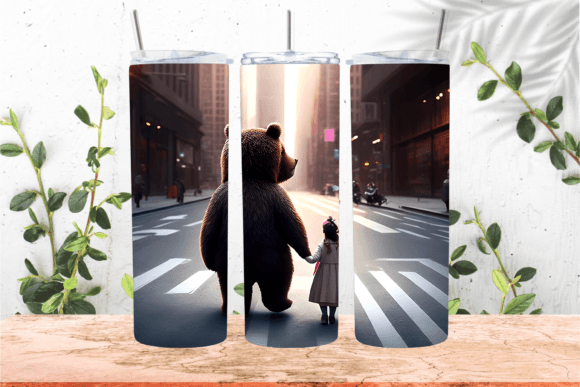
Bear Skinny Tumbler Wrap Sublimation
First Impressions: A Friendly, Flexible Design That Feels Like Home
When I opened the Bear Skinny Tumbler Wrap Sublimation file, what struck me wasn’t just the clean bear motif—it was how immediately *usable* it felt. The layout flows with the natural curve of a 20 oz skinny tumbler, but more importantly, its proportions and spacing translate surprisingly well to flat embroidery surfaces. It’s not overly fussy—no tiny antlers or micro-paws that’ll vanish under satin stitch—but it’s not generic either. There’s warmth in the bear’s posture, simplicity in the line work, and breathing room built into the design that gives your thread room to breathe. As a designer who regularly adapts sublimation graphics for machine embroidery, I appreciate when a Print Templates asset respects stitch reality instead of just screen appeal.
Where This Design Actually Shines (and Where It Surprises)
I tested Bear Skinny Tumbler Wrap Sublimation on a few real-world projects last week: a linen tea towel for a local café launch, a cotton baby onesie for a friend’s shower gift, and a custom embroidered patch for a small-batch apron line. In each case, the design held up—not because it’s “perfect,” but because its intentional minimalism works *with* embroidery, not against it.
- Tote bag design: Stitches cleanly across canvas without distortion; the bear reads clearly even at 4.5" wide.
- Sweatshirt embroidery: Works beautifully on mid-weight fleece—no puckering, thanks to balanced stitch density and open negative space.
- Embroidered patch: Holds crisp edges after heat-sealing; the outline reads as intentional, not pixelated.
- Baby embroidery: Soft enough for onesies when stitched with 40wt poly, yet bold enough to avoid looking washed out.
- Holiday embroidery: Paired with red-and-cream thread on a kitchen towel, it read as cozy—not cutesy—and got genuine compliments at a craft fair.
Real Talk: When to Proceed With Care
This isn’t a one-size-fits-all embroidery file—and that’s okay. Bear Skinny Tumbler Wrap Sublimation performs best when you match its personality to the right context. Avoid forcing it onto:
- Small hoop sizes (under 4"): The wrap’s natural width needs breathing room—tight cropping loses charm and risks awkward truncation.
- Stretchy fabric like jersey or ribbed knits: Without proper stabilizer and careful hooping, the bear’s clean lines can blur or skew.
- Dense, textured fabrics (e.g., heavy terry, bouclé): Fill stitch areas may sink or lose definition—test first.
- Dark fabric without contrast testing: The design relies on shape over fine detail, so thread color choice matters more than usual. A light gray bear on navy won’t pop like charcoal on cream.
- Curved surfaces like caps: While it’s built for tumblers, cap crowns introduce compression. You’ll need to adjust placement and possibly scale slightly—or use it only on front panels where curvature is gentler.
What It Adds to Your Finished Product (Beyond Just “Cute”)
Using Bear Skinny Tumbler Wrap Sublimation in a handmade product does more than decorate—it signals intention. Customers notice when a design feels considered, not copied. On an Etsy listing for personalized sweatshirts, this bear reads as warm, approachable, and quietly professional—not mass-produced. For boutique branding, it lends consistency without rigidity: same core motif, different thread palettes per season. And for holiday embroidery or personalized gifts? Its gentle energy avoids trend fatigue. It doesn’t scream “look at me”—it invites touch, recognition, and repeat purchase. That kind of quiet trust builds craft business credibility faster than any flashy font ever could.
Practical Embroidery Designer Notes Before You Stitch
Before committing to your first run, here’s what I do—and recommend you do too:
- Test on scrap fabric matching your final substrate—especially if using blends or textured weaves.
- Check thread color contrast in natural light; what looks balanced on screen may mute on fabric.
- Review stitch density visually: Does the fill feel even? Are satin-stitched edges smooth, or are there thin spots prone to snagging?
- Confirm hoop size compatibility—this design benefits from a 5x7" or larger hoop for optimal tension and clarity.
- Inspect small details at actual stitch size: Are corners sharp? Does the bear’s ear hold shape, or does it soften into a blob?
- Test in black-and-white mockups to assess value contrast before choosing thread.
- Compare light and dark fabric backgrounds side-by-side—you’ll often find one background makes the design feel more “finished.”
- Use appropriate stabilizer: Tear-away for stable wovens, cut-away for knits, and lightweight fusible for delicate layers.
- Verify licensing terms before selling finished items or digital embroidery files—Bear Skinny Tumbler Wrap Sublimation is a Graphics asset, and commercial use rights vary by seller.
Final Thought: A Design That Serves the Maker, Not Just the Market
Bear Skinny Tumbler Wrap Sublimation isn’t trying to be everything. It’s a focused, adaptable piece of design assets—thoughtful in its restraint, generous in its flexibility. Whether you’re an Etsy seller batching holiday embroidery, a small shop owner building cohesive merchandise, or a hobbyist stitching personalized gifts for loved ones, it gives you room to interpret, not just replicate. It reminds me why I still love this work: not for the flashiest file, but for the ones that stitch true, sell well, and make people smile when they unbox something handmade. That’s the quiet power of a well-considered Graphics template—and why this one earned a permanent spot in my working library.